
Every fall, many students leave for Canada from their home countries, and by the end of 2023, the number of international students in Canada exceeded one million (The Globe and Mail, 2024). While many just think about the benefit of studying abroad such as a better education and language environment, a common issue not often talked about is feeling loneliness. That became a huge problem in the COVID-19 pandemic and is still a problem right now (Su & Gordon, 2024). Being far away from family, many report feeling lonely.
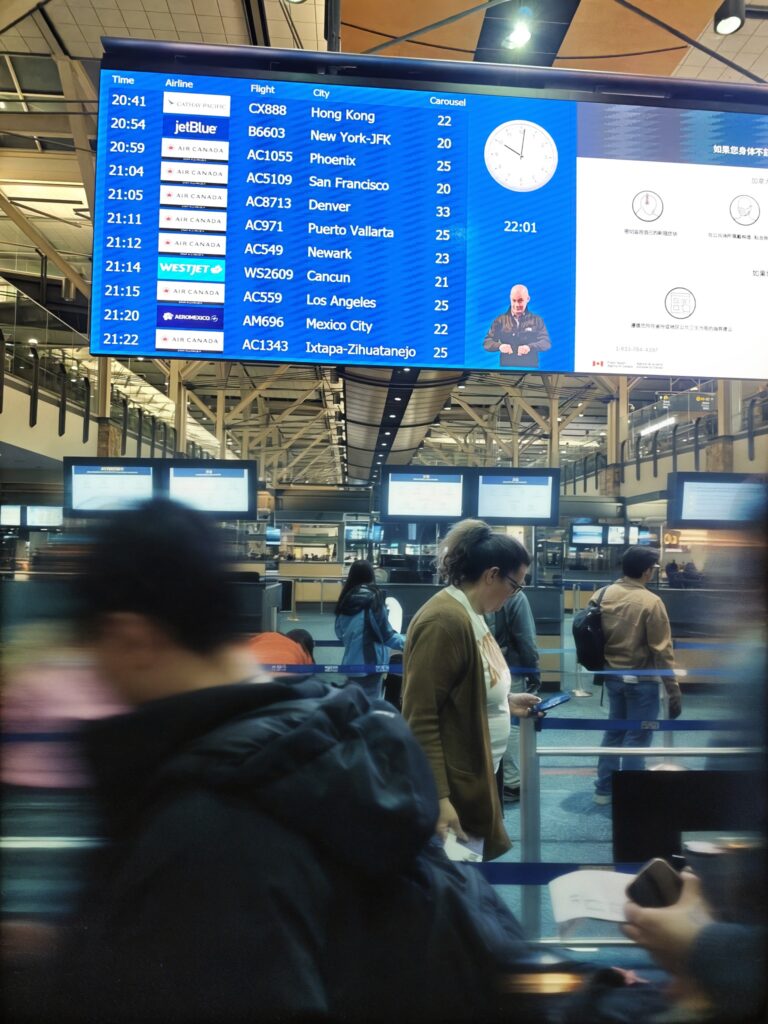
Newcomers walk through the arrivals hall at a Canadian airport, for most international students, this is where the study begins. Taken by Guoping Luo, 2026
More Than Homesickness
Sometimes the hardest part of studying abroad for international students isn’t the course work, but life. Once they’ve left their family and established friendship circles, they’re often shocked to find that spending time with fellow students who speak the same language isn’t enough to truly integrate into their new social circles. Research determined that about 55% of roughly 600 international students were at risk for depression, and about 50% were at risk for an anxiety disorder. The students interviewed described loneliness, fatigue, panic attacks and social isolation(Varughese & Schwartz, 2022).

An international student takes the bus alone after class, watching the city through the window. Taken by Guoping Luo, 2026
Friendly, but Not Friends
Many international students have had the same experience: their local classmates are usually very friendly and willing to talk in class, but these interactions rarely turn into close friendships.
“A salient barrier is the human tendency to socialize with similar others.” says Xu Zhao, a researcher at the University of Calgary (2019).
This is not shocking. People with same language and background tend to get along more easily. Thus many international students socialise more with others from their home country. This would be more comfortable. But in the long run it creates an invisible wall between them and the students here. Some students do some activities and meet new people upon arriving in Canada, but after a few failed attempts to connect they eventually stop trying.

International students gather around a Mahjong club booth during UBC’s club recruitment day. Taken by Guoping Luo, 2026
The Language Wall
Language is also a reason. Many foreign students can do well in academic writing and tests, but this is not the same as in daily life. Local students speak quickly and frequently use slang or jokes; therefore, they cannot respond immediately even if they understand. Accent problems have also led some to feel that they cannot speak naturally. Gradually, they are unable to function properly in society. Thus, they were even more isolated socially and therefore felt more lonely.
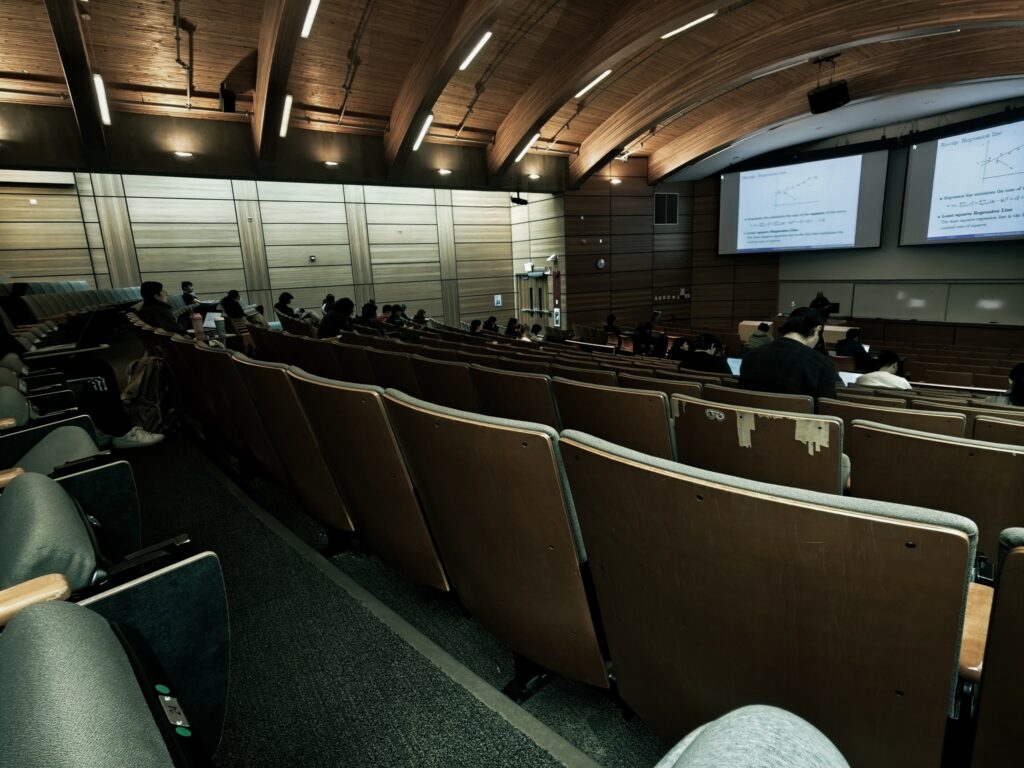
A student sits alone in a lecture hall while classmates gather in groups nearby.Taken by Guoping Luo, 2026
A Path Forward
The good news is, it gets better. CBIE did a study and found that the longer international students stay in Canada, the more comfortable they feel approaching locals and becoming part of the campus culture (CBIE, 2016). A lot of schools have started doing things to help too — peer mentorship programs, international student clubs, free counseling. Those don’t solve everything, but they give people a start. Still, it can’t just fall to international students to fix it. The locals, the professors, even just the person next to you in lecture — anybody can make the difference by going beyond a polite “hey” and actually meaning it.

A street dancer performs against the Vancouver skyline at night.Taken by Guoping Luo, 2026
References
Canadian Bureau for International Education. (2016). The integration challenge: Connecting international students with their Canadian peers. https://cbie.ca/wp-content/uploads/2017/07/A-World-of-Learning-HI-RES-2016.pdf
Su, C., & Gordon, L. (2024). Exploring loneliness, social support and adaptability of international students in Canada during COVID-19. Open Journal of Trauma, 8(1), 28–40. https://doi.org/10.17352/ojt.000047
The Globe and Mail. (2024, January 19). Number of international students now exceeds one million, official figures show. https://www.theglobeandmail.com/politics/article-number-of-international-students-now-exceeds-one-million-official/
Varughese, A., & Schwartz, S. (2022, January 24). The pandemic exposed the vulnerability of international students in Canada. The Conversation. https://theconversation.com/the-pandemic-exposed-the-vulnerability-of-international-students-in-canada-174105
Zhao, X. (2019, July 24). Newcomers and Canadian high school students are friendly, but not friends. The Conversation. https://theconversation.com/newcomers-and-canadian-high-school-students-are-friendly-but-not-friends-111453
Leave a Reply